
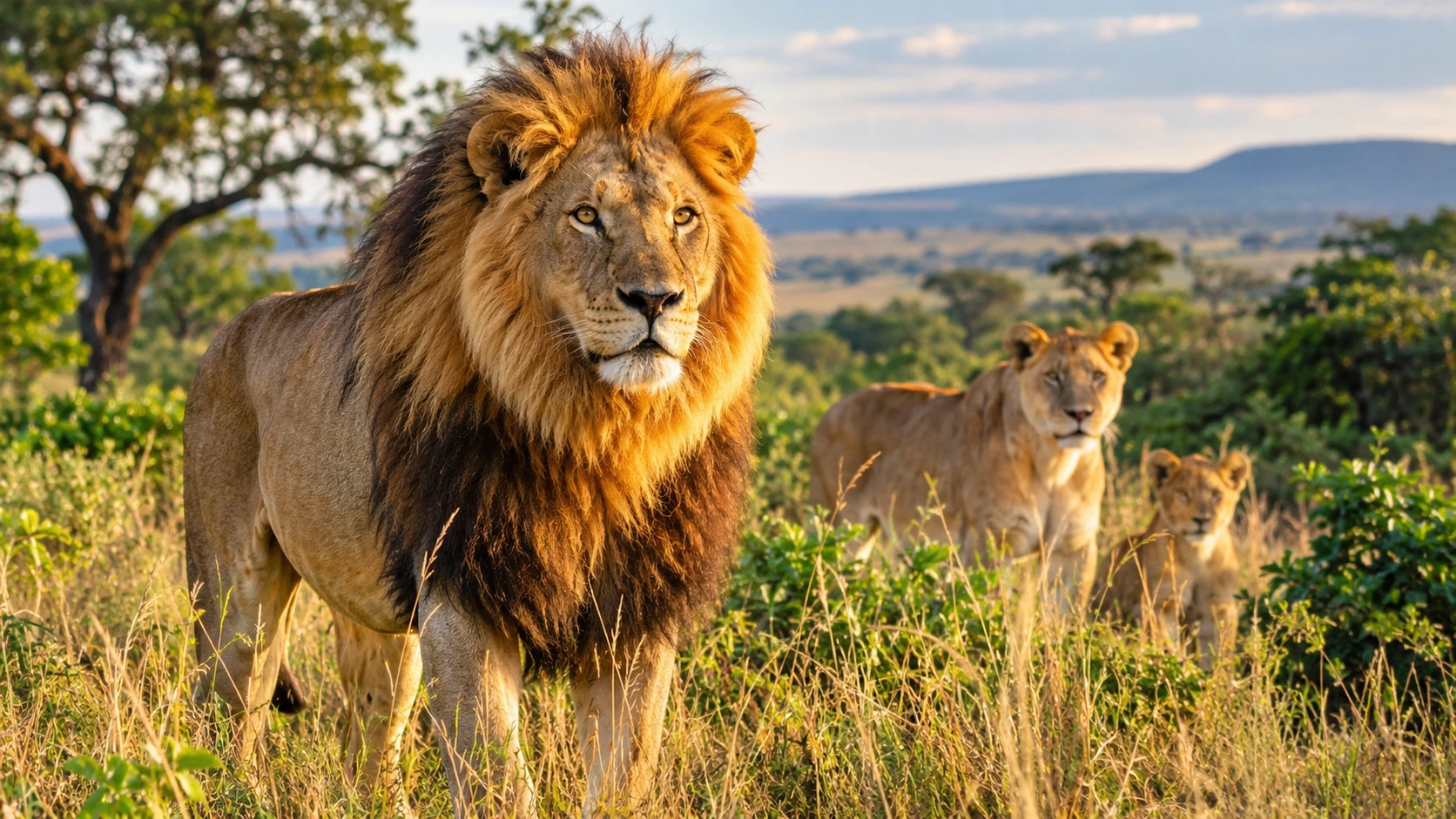
Ask anyone to name a wild animal, and lions come up fast. We call them the “king of the jungle.” Funny thing is, most lions never see a jungle. They roam open grasslands and dry plains.
They’re also the only big cats that truly live as a group. Family first, always. They share food, raise young together, and guard each other.
Don’t worry, you won’t need any science background here. I’ll keep things simple. Every fact is short and easy to read. By the end, you’ll know how big lions get, how they hunt, and why they need our help.
So let’s take a simple walk through the lion world. I’ve tried to make it easy to follow, so get comfortable and dive in.
Easy Lion Facts at a Glance
| Topic | Quick Fact |
|---|---|
| Average male weight | About 190 kg |
| Average female weight | About 126 kg |
| Mane length | Up to 16 cm |
| Roar distance | Up to 5 miles |
| Biggest meal | Up to 40 kg of meat |
| Wild lions left | As few as 23,000 |
Think of this table as a simple warm-up. Now for the details.
The Top 10 Lion Facts, Made Simple
1. Almost All Wild Lions Live in Africa
Where do lions live? The simple answer is Africa. Wild lions come in two recognised types. The African lion lives south of the Sahara desert. The Asiatic lion has just one small home, around Gir Forest National Park in western India.
Here’s a twist. Lions from west and central Africa are closer cousins to India’s lions than to the lions of southern and eastern Africa. Who knew? Nature’s family tree isn’t always easy to guess.
2. Male Lions Are Very Heavy
A grown male weighs about 190 kg, which is nearly 30 stone. Females are lighter at around 126 kg, or almost 20 stone.
That weight is useful. It gives them the strength to take down big animals and protect their group. It’s easy to see why they sit at the top of the food chain. For a simple comparison, picture two and a half adults standing on a scale.
3. Baby Lions Start Out Spotty
Newborn cubs wear spots and rosettes on their sandy fur. As they grow, most of those marks fade away. The change is simple: older lions end up with plain coats. It’s easy to spot the markings in cub photos, but good luck finding them on an adult.
4. Manes Tell a Story
Most male lions grow a mane as they age. It can stretch up to 16 cm long and signals strength and status.
Not every male gets one, though. In Kenya’s Tsavo National Park, lions without manes are quite common. Experts link this to the local climate. The simple truth? A lion doesn’t need a mane to be a real lion.
5. Cubs Are Raised Together
A pride is basically a lion family. It usually includes related females, their cubs, and one male or a small team of males who keep watch.
The mothers share the parenting. If a female has milk, any cub can drink from her. It’s a simple system, and it clearly works.
6. Lions Can Get Water from Plants
Lions can survive in very dry places, like the Kalahari Desert. Life there isn’t easy. Their answer is simple: use whatever water you can find. Most of it comes from the animals they eat. They’ll also drink from plants, such as the Tsamma melon.
7. Lions Are Big Eaters
One lion can eat up to 40 kg of meat in a single meal. That’s around a quarter of its body weight. It’s easy to picture, really: think of a very large dog’s weight eaten in one sitting.
Their tongues help a lot. They’re covered in sharp, pointed bumps called papillae, and those scrape meat clean off the bones. Nature made that job easy.
8. Lions Hunt in Storms
Most lion hunts happen at night. Their eyes are built for the dark, and that gives them a big edge over prey.
Storms help them too. Noise, rain, and wind make it harder for prey to see or hear them coming.
Lionesses even split up the work. Some take the “centre” role. Others take the “wing.” The wings chase prey toward the centres. It’s a simple plan, and it shows real teamwork. Even so, no hunt is easy.
9. Lions Roar Together
Lions are the only known cats that roar together. Even small cubs join in with soft mews. A full session often lasts about 40 seconds.
Prides roar to mark their turf. It’s a simple but loud message, and it can travel up to 5 miles. That makes it easy to tell when a pride is close.
10. There Are Fewer Lions Than You Think
Only about 23,000 lions may be left in the wild. Compare that with roughly 415,000 wild African elephants. The gap is easy to see. Lions have also vanished from over 90% of the places they once lived. The message is simple: they need help.
What Has Happened to Lions?
The news isn’t good. African lion numbers have fallen by more than 40% in just three generations. The reasons are easy to understand.
Here’s a simple look at the main threats:
| Threat | What Happens |
|---|---|
| Conflict with people | Lions are killed to protect people and livestock |
| Loss of prey and habitat | Growing towns, farms, and poaching of antelope leave less food |
| Climate change | Droughts and late rains hurt the animals lions hunt |
| Illegal trade | Lion bones are in demand as a substitute for tiger bone in some traditional medicine |
When wild prey runs low, hungry lions may go after farm animals. That hurts local families, who can lose a big part of their income. Anger builds, and more lions get killed. The simple truth is that people and lions need shared space. It’s easy to see how the trouble starts, and hard to stop.
People Are Working to Help
There is hope. Conservation groups are helping to set up and improve protected areas in east Africa. They also team up with local people to build conservancies. These are unfenced community lands kept safe for wildlife. The idea is simple: wildlife stays safe, and communities earn money, for example from tourist lodges.
Protecting lions is not a simple job. In Kenya, the Mara Predator Conservation Programme tracks and protects lions. It runs campaigns against poisoning and takes school children out to see local wildlife. It also helps families build stronger livestock pens. Simple ideas like this can save lives, both human and animal.
Kenya is also getting its first national lion census, backed by partners. It will show how many lions live there and how best to protect them. The idea is easy: count the lions first, then guard them well.
Want to read more? The IUCN Red List shows how close different species are to danger. Panthera is a group that works for wild cats. National Geographic has easy-to-read animal guides.
Simple Ways You Can Help
Helping lions can be easy. You don’t have to travel to Africa.
- Learn and share. Tell friends and family what you found out. It’s an easy first step.
- Travel wisely. Pick eco-friendly tours. Simple choices matter.
- Support trusted groups. Even a small gift is an easy way to help.
- Say no to wildlife products. Never buy goods made from wild animal parts. It’s a simple rule.
Frequently Asked Questions
1. Why is the lion called the “king of the jungle”?
The simple reason is its strength and royal look. In truth, lions mostly live in grasslands and dry areas, not thick jungles.
2. Where do wild lions live today?
The easy answer is Africa, south of the Sahara. One small group also lives near Gir Forest National Park in India.
3. What do lions eat?
Lions are meat eaters. They hunt large animals, and they can eat up to 40 kg in one meal. That’s about a quarter of their body weight. The simple rule is that if it’s big prey, a pride can take it on together.
4. Is it easy to tell male and female lions apart?
Often, yes. Males are bigger and usually have manes. A simple clue is the mane. But some males, like those in Tsavo, have none.
5. How many lions are left in the wild?
The easy answer: there may be as few as 23,000. They’ve disappeared from over 90% of their old range.
Conclusion
The lion’s story is simple at heart. Lions need space, food, and safe homes. Giving them that isn’t always easy, but many people are trying. Sharing what you learned today is an easy start. It’s easy to care about animals this amazing. Every small step helps keep the king of the savanna roaring for years to come.